
WPC Laboratory:
the evolution of composite wood
Woodn Greenwood composite WPC woods surpass the limits of natural wood to inspire increasingly innovative construction that has less and less of an impact on the environment.
Two revolutionary formulas, the result of twenty years of experience and the high specialization of our Research & Development departments, which blend two different types of recyclable polymers and conifer wood flour with FSC certification®, all of Italian origin and obtained from scraps of other processes. Thus comes to life a new advanced and durable material, capable of offering the construction industry high-functional technical performance while combating the deforestation of the planet.
WPC is a lightweight yet durable material with a refined and elegant appearance. The right balance of wood and polymer at the core of the products makes them highly resistant to water, fungi and parasite attacks, and weathering, therefore They can be used in any weather condition and at all latitudes, even in marine environments. Exposure to UV rays does not alter the color, which remains stable over time without requiring surface treatments.
Woodn and Greenwood, given their different nature deriving from their composition, differ in colors and color rendering, but they can be perfectly matched to allow maximum customization for the designer.
WPC WOODN
Made of recyclable PVC polymers
WPC WOODN is an original composite wood, a Species Unica on the international scene.
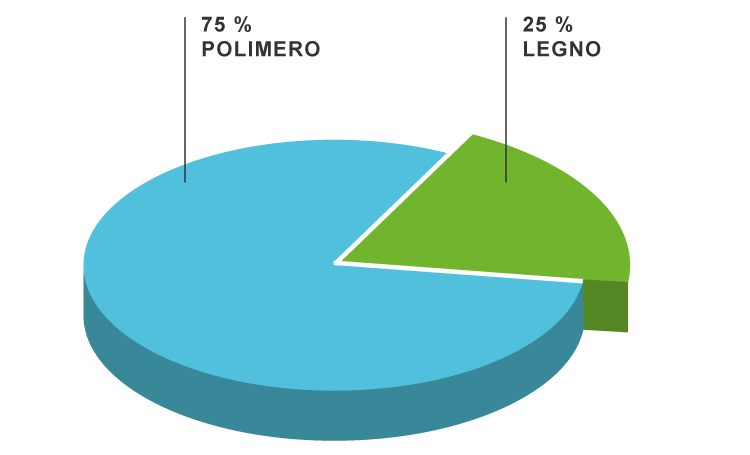
The compound is composed largely of PVC, a thermoplastic polymer that protects surfaces and is the only one classifiable for fire resistance. The result is a lightweight, renewable, and moldable technical material for custom profiles.
THE ADVANTAGES OF PVC IN THE CONSTRUCTION INDUSTRY:
1_ It is versatile and lends itself to a wide range of applications.
2_ It is liquid-resistant and 100% recyclable.
3_ Thanks to its composition and mechanical properties, PVC is the most suitable polymer for outdoor applications, exposed to UV rays or weathering.
4_ It is safe and inert, fire-resistant, virtually non-flammable, self-extinguishing, and does not contribute to flame propagation.
WPC GREENWOOD
Designed for decking
WPC GREENWOOD is an engineered wood with a concept complementary to WPC Woodn.
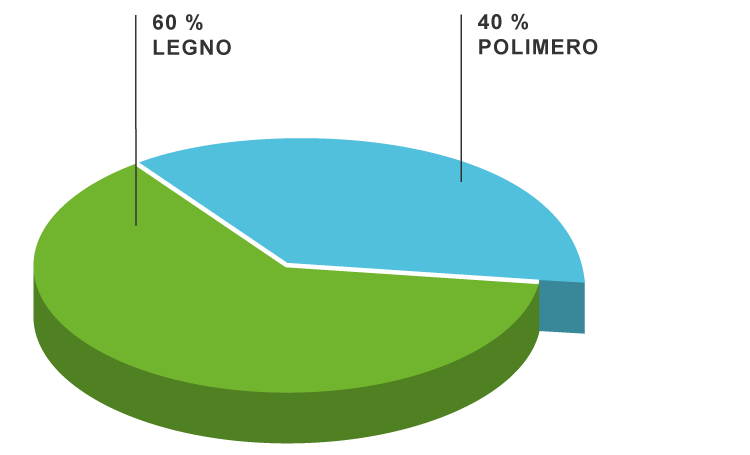
In fact, it is composed of 60% wood powder and 40% plastic, specifically polypropylene. This particular polymer component guarantees certified performance in terms of dimensional and color stability, making it the material ideal for floor applications. On the other hand, the higher percentage of softwood fiber enhances the grain in the pulp, making the touch & feel perception of the planks closer to that of wood.
THE PROCESSING OF OUR WPC
Woodn Greenwood designs and manufactures both the “raw material”—WPC—and the profiles in-house using an extrusion process. The on-site 100% production cycle allows for complete design customization and enables the company to transform all waste into new raw material.
The key factors in the production of composite wood are essentially 3:
1_ THE RESEARCH, SELECTION, AND SOURCING OF RAW MATERIALS: The R&D department selects all raw materials used during the production process, such as polymers, wood fibers, and particularly additives, from Italian and European suppliers. This process is constantly being improved, and it will shape all products that are to be installed worldwide under any climatic conditions.
2_ FULL CONTROL OF THE FORMULATION: As specialized manufacturers in the production of this material, we create our formulas in-house, knowing their limits and potential. This allows us to provide multi-year warranties on all our systems, ensuring the safety and durability of the finished product over time.
3_ EXPERIENCE AND SPECIALIZATION IN EXTRUSION: We internally control all the phases and parameters of the extrusion.
Once the selection of raw materials and the formula have been tested and approved, several factors are involved in the actual production process:
• The granulation and the measurement of the material's moisture content.
• The homogeneous mixing of all components and additives.
• The temperature and melting dynamics of polymers.
• Profile calibration and continuous monitoring of physical, mechanical, and aesthetic parameters.
• The extrusion speed and output.
• The custom in-line cut.
Extrusion process
Industrial extrusion through more than 50 different dies and 9 dedicated lines powered by a photovoltaic field. A closed-loop cooling circuit that recycles water.
CERTIFICATIONSQUALITY CONTROL
Hourly visual and software-based quality control. Manual brushing and finishing. Custom machining using CNC machines.
FINISHESLOGISTICS SERVICE
Tailored packaging based on the type of transport and national door-to-door logistics management by truck or overseas, via container by ship or by air
COMPANY10 REASONS TO CHOOSE OUR WPC
- 1_ It is UV resistant
- 2_It is suitable for outdoor applications
- 3_It is resistant to water, moisture, and mold.
- 4_It can be processed on-site
- 5_Production is flexible (Tailor-Made)
- 6_It does not need to be installed in a “controlled environment”
- 7_It does not require protective finishes
- 8_Does not require mandatory cleaning
- 9_100% is recyclable
- 10_It is thermoformable for curved applications
TEST AND RELIABILITY
Woodn Greenwood systems, in addition to contributing to LEED certification,® of the buildings, are periodically subjected to Certification paths at accredited laboratories, to guarantee designers and builders the declared performance and sustainability.
They can be found inside the technical documentation:
• Fire resistance testing, according to US standards (NFPA 285, NFPA 268)
• Test di resistenza all’umidità e controllo delle proprietà meccaniche.
• Test di resistenza allo scivolamento (DIN e AS)
• Test di emissione di VOC
• Test di assorbimento acustico (ASTM C423)
• Test di resistenza all’attacco di termiti (ASTM D3345-22)
• Test di resistenza al carico del vento (NOA emessa dal Miami Dade County Department of Regulatory and Economic Resources (RER)
• Test SRI – indice di rifrazione solare
• Doghe Woodn Fire Performance resistenti al fuoco, secondo le normative europee EN 13501 - 1:2018 in classe B-s2,d0 - disponibili su richiesta
• Doghe Greenwood Fire Performance resistenti al fuoco, secondo le normative europee EN 13501 - 1:2018 in classe CFL-S1 - disponibili su richiesta




Certificato ISO9001 | Mappatura LEED® | Certificato FSC®
Domande Frequenti
Rispondiamo alle tue domande
WPC è l’acronimo di Wood Plastic Composite, un materiale composito formato da farine di legno, polimeri plastici e additivi. Un materiale nato nei primi anni ’70 nell’industria automotive, ma che per le sue straordinarie proprietà si è presto affermato come alternativa ecologica e durevole ai più tradizionali materiali edili.
Il laboratorio WPC interno a Woodn Greenwood ha sviluppato 2 formule per i propri prodotti: il WPC WOODN, con una parte polimerica preponderante, è destinato a rivestimenti esterni, controsoffitti e frangisole; il WPC GREENWOOD, che contiene circa il 60% di farine di legno di conifera, è invece stato progettato per applicazioni a pavimento, passerelle e aree a bordo piscina.
Il WPC risulta più durevole e stabile esteticamente e strutturalmente rispetto al legno naturale. Il colore si mantiene anche nel lungo periodo. Il materiale è resistente al fuoco e austoentiguente in caso di incendi, e refrattario ai parassiti. Le superfici in WPC sono antiscivolo e idrorepellenti, le doghe non si fessurano e non producono schegge. Inoltre, il WPC richiede una manutenzione minima.
Anche nel caso di applicazioni outdoor, il legno tecnico WPC non richiede alcun trattamento o verniciatura protettiva, perché è la componente polimerica a rendere il materiale impermeabile e duraturo.
Il WPC richiede una manutenzione minima, in special modo se raffrontata a quella del legno naturale. Dopo la prima applicazione, è sufficiente una pulizia con acqua ad alta pressione inferiore a 80 bar. La resa estetica resta inalterata nel tempo. In ogni caso, nell’Technical Area A short maintenance and handling manual for the slats is available.
Il WPC è un materiale 100% riciclabile. Nel caso di Woodn Greenwood in particolare, poiché il ciclo produttivo è completamente in-site, ogni scarto di produzione viene da noi trasformato in nuova materia prima, da riutilizzare nei successivi processi di estrusione.